“In the Ratroom” selected for Best Australian Essays 2011, edited by Ramona Koval
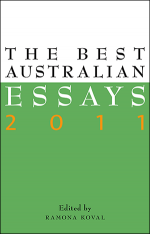
‘Turn the page and hear the voices within …’—Ramona Koval
The Best Australian Essays 2011 offers up bliss and illumination in equal measure – from the pleasures of the flesh to the events that convulsed the world in a year of change. Paul Kelly meditates on Frank Sinatra, and Robert Manne excavates the past and thoughts of Julian Assange. Inga Clendinnen dreams on cricket memories, and Anna Krien delves into the saga of the St Kilda schoolgirl. There is Peter Robb on Italian food, Anthony Lane on News of the World, Gail Bell on rats and Richard Flanagan on photography. This is a collection with something for everyone that never wavers in its quality.
Contributors include: Gillian Mears, David Malouf, Nicolas Rothwell, Robert Manne, Anthony Lane, M.J. Hyland, Craig Sherborne, Anna Krien, Inga Clendinnen, Gail Bell, Helen Elliott, Morris Lurie, Maria Tumarkin, Andrew Sant, Shakira Hussein, Lian Hearn, Amanda Lohrey, Paul Kelly, Peter Robb, Clive James, Delia Falconer, Richard Flanagan and Andrew O’Hagan.
Pub date: November 2011
RRP: $29.95
ISBN: 9781863955478
Imprint: Black Inc.
Format: PB
Extent: 320pp
Reviews & Interviews: Read an interview with Ramona Koval on the Black Inc. blog
Buy the ebook: Readings | iBookstore
A Quiet Anniversary: AIDS 30 years on

In the November 2011 issue of The Monthly Magazine, “A Quiet Anniversary” by Gail Bell marks the thirtieth anniversary of the discovery of AIDS, “the wasting disease that went by many names”. Bell reviews Australia’s response in effectively “taming” the disease over 30 years – a “good news story”. Ben Naparstek, editor.
“Thirty years since the disease that came to be known as AIDS was identified, there have been no fireworks, no flagpoles planted on high, previously inaccessible peaks, and, outside the busy network of HIV/AIDS organisations and clinical researchers quietly getting on with their work, there was little to tip off the wider community to this ‘pearl’ anniversary.”
Prescribing Behaviour: The rush to diagnose ADHD
In a new essay in the October 2011 edition of The Monthly Magazine titled “Prescribing Behaviour”, Gail Bell considers the rush to diagnose ADHD in children. From Ritalin to Catapres to Risperdal, a cocktail of potent drugs are regularly administered to kids for what is essentially a behavioural disorder – one likely to diminish in adulthood. Bell interviews teachers and students in special learning environments to see how the young members of the Ritalin club are faring, and whether there is a better alternative. Ben Naparstek, Editor
“There’s no doubt that an out-of-control kid put on Ritalin settles very quickly. Do I wish there was another way? Yes. The reality is, as teachers we can’t do our jobs when a kid is climbing the walls.”
In the Rat Room: Reflections on the breeding house
A new essay in the July 2011 edition of The Monthly Magazine, “IN THE RAT ROOM”, sees Gail Bell reflecting on her time as a laboratory assistant between 1969 and 1971. Bell catalogues the “ruthlessly eugenic” practices that were uncontested in the scientific world at the time, and explores the philosophical assumptions behind the treatment of animals in testing environments. Bell confronts us with realities about the animal experience that are particularly poignant given recent animal cruelty revelations. Ben Naparstek, Editor
“It never occurred to me that rats might like classical music, just as it never occurred to me that they might appreciate having their lives enriched by toys or games. These guys were headed for the scalpel if they were lucky, and the torture chamber of drugs or electrodes if they weren’t.”
Inside the pillbox: Bullying in the workplace
In the April 2011 edition of The Monthly Magazine, Gail Bell takes issue with a workplace bully in “Inside the Pillbox”. The pain of watching a fellow worker succumb to the bully’s bag of dirty tricks prompts Gail to intervene with management, only to find herself fobbed off with meaningless promises. As she works through the recommended published approaches to dealing with workplace terrorism—and finds them wanting—she ends up facing “certain miserable truths: bullying, like envy and greed and other sins I can think of, doesn’t ever really go away”.
Awake at 3am, Gail entertains revenge scenarios. She turns away from the “anti-bullying departmental manuals” and opens up Robert Browning’s poem The Laboratory, deriving a perverse pleasure from the courtesan’s question: “which is the poison to poison her, prithee?”
Taking Care
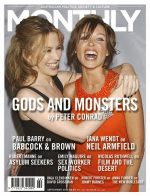
In the September 2010 edition of The Monthly Magazine, Gail Bell writes movingly about the day her mother-in-law has to leave her home of sixty years, in a piece called “Taking Care”. Faced with choosing what to take with her to the nursing home, she is lost for words. “If she gives it all away, what’s left of her life? What do all the treasures she’s polished and guarded, the furniture passed down from her own parents, the souvenirs from her travels really mean?”. The family gathers to help her pack, but end up feeling like “cat burglars” ransacking the house. The nursing home is a grim parody of the welcoming home she created for her family. Now she will live in a single room. Beyond her door is “an alien world of shuffling folk and time-starved staff.” Bell tries to imagine how this home-loving woman will manage the painful transition to “care”.
Heart to heart
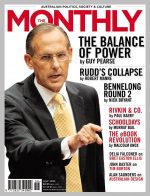
In the July 2010 edition of The Monthly Magazine, Gail Bell writes a very personal reflection on her four months of illness, in a piece called “Heart to Heart”. When her sister (a crisis counsellor) visits, she tells her story again. “I’m so sick of trying to make sense of it, I skim across the top, only breaking the surface in shallow strikes. Three different ambulances, a cardiologist, intrusive tests, drugs that made my ears thump, pain that pinned me to the bed.” Still traumatised by the hospital’s misdiagnosis, Gail appeals for credible, therapeutic answers when her sister, in a surprise move, suggests a psychic alternative.
Liquid handcuffs: The methadone program at 40
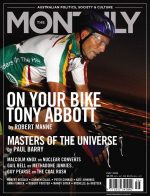
In the May 2010 edition of The Monthly Magazine, Gail Bell reflects upon 40 years of the methadone program in Australia, in a piece called “Liquid Handcuffs”. Tracing the history of the program’s operation from its inception in a small clinic in western Sydney in 1970, Bell also charts the changing public and medical perceptions of the treatment of addicts since the early abstinence-based models.
“Methadone changed the way addicts stepped down off the heroin express. Instead of a stopover in a transit lounge, the travellers changed platforms for a parallel line with quieter, more comfortable carriages. The introduction of a long acting synthetic opioid, given once daily under supervision, addressed the toughest challenge to quitting, the intolerable doof doof of unsatisfied hunger.”
Ghost Writers
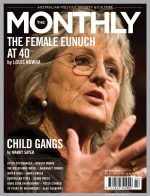
In the March 2010 issue of The Monthly Magazine Gail Bell considers the “strange transaction” entered into when people (like herself) visit the homes of dead authors.
Ghost Writers looks at Virginia Woolf’s admonition: “I do not know whether pilgrimages to the shrines of famous men ought not to be condemned as sentimental journeys” and asks if literary voyeurism is an act of trespass or a valid expression of our need to connect.
“…erudite, provocative and entertaining.” Ben Naparstek, editor.
Golden Eye
In the November 2009 issue of The Monthly Magazine, Gail Bell recollects a case history from 20 years ago. Writing for The Nation Reviewed she tells of her encounter with Felix, the man with the Golden Eye.
Small gold flakes, like glitter, float downwards from somewhere—it’s hard to describe—settling on whatever I look at.
Does Felix have a strange medical condition or are his visions a gift?
Gail “reflects on the mystery and fleeting joy” of this unusual phenomenon. (Ben Naparstek, editor)